Peer Exchange

4 experts are featured in this series

In this HCPLive Peer Exchange series, expert panelists discuss key updates and clinical insights related to ASCVD. The discussion focuses on updated cardiovascular risk assessment guidelines and LDL cholesterol goals, practical strategies for initiating and escalating lipid-lowering therapy, and the critical role of patient communication, shared decision making, and long-term adherence in closing the persistent gap between guideline-recommended targets and real-world clinical outcomes.
4 experts are featured in this series.

Expert endocrinologists examine growth hormone deficiency across pediatric and adult populations, covering etiology, diagnosis, treatment options including long-acting analogs, real-world registry data, transition-of-care challenges, and strategies for optimizing long-term patient outcomes across the continuum of care.

3 experts are featured in this series.

In this HCP Live Peer Exchange series, expert panelists discuss key updates and clinical insights related to Psoriasis. The discussion focuses on the evolving treatment approaches in psoriasis and how they aim to achieve sustained disease control beyond short-term skin clearance. The panelists evaluated long-term efficacy and safety data to better understand durability of response and the potential for sustained remission in psoriasis. They also explored how to incorporate evidence-based, remission-focused strategies into clinical management and patient communication in everyday practice.

This HCPLive Peer Exchange series provides a comprehensive evaluation of Wilson disease, from its underlying pathophysiology and clinical manifestations to the diagnostic criteria that impact long-term patient quality of life. The panelists analyze the safety and efficacy of current and emerging therapeutic paradigms while offering practical, data-driven strategies to overcome management challenges and improve medication adherence.

Experts featured in this series.

In this HCP Live Peer Exchange series, expert panelists discuss key updates and clinical insights related to Psoriasis. The discussion focuses on the pathophysiology of hypercortisolism, and how it contributes to hypertension and cardiovascular risk. The panelists will review the current and emerging treatment landscape and consider how evolving therapies may influence patient outcomes. Finally, the panelists will discuss practical approaches to cardiovascular management, including interdisciplinary collaboration and referral considerations in the care of patients with hypercortisolism

In this HCPLive Peer Exchange series, expert panelists discuss key updates and clinical insights related to obstructive hypertrophic cardiomyopathy. The discussion focuses on the pathophysiology, symptoms, and diagnostic approaches for obstructive hypertrophic cardiomyopathy (oHCM) to provide a foundation for patient management. It also examines treatment strategies, best practices for optimizing care, and how recent clinical trial data can be applied to improve outcomes in oHCM patients.

3 panelists

In this HCPLive Peer Exchange series, expert panelists discuss key updates and clinical insights related to plaque psoriasis. The discussion focuses on the clinical and practical challenges of managing moderate to severe plaque psoriasis, while evaluating the evolving treatment landscape with a particular emphasis on IL-23 inhibitors and the value of matching adjusted indirect comparisons in evidence-based decision making. The panelists also share best practices for integrating comparative evidence into real world practice to guide treatment selection, support patient centered discussions, and optimize long term outcomes.

4 panelists

In this HCPLive Peer Exchange series, expert panelists discuss the critical link between chronic kidney disease (CKD) and cardiovascular risk, emphasizing the necessity of early diagnostic testing. The multidisciplinary panel—comprising a cardiologist, a family physician, and a cardiovascular clinical pharmacist—explores how the integrated cardio-kidney-metabolic (CKM) framework can be used to improve patient outcomes

4 experts are featured in this series.

This program brings together leading nephrologists to discuss the evolving landscape of IgA nephropathy, highlighting advances in understanding disease mechanisms and the emergence of targeted therapies. The panel reviews key clinical data, explores the role of novel treatment strategies such as B-cell modulation, and examines how these innovations may reshape modern patient management.

Four experts featured in this series.

Panel of experts will discuss the persistent cardiovascular risk among patients with a history of ASCVD events and the importance of LDL-lowering in secondary prevention. Experts also evaluate current and emerging PCSK9-targeting therapies and share practical strategies for integrating PCSK9 inhibition into post-event lipid management to achieve optimal LDL-C control and improve long-term outcomes.

4 experts are featured in this series.

This series brings together experts to discuss advances in the early recognition, diagnosis, and treatment of transthyretin amyloid cardiomyopathy (ATTR-CM). The panel highlights evolving evidence on TTR stabilizers and gene-silencing therapies, as well as emerging clinical data that are shaping future approaches to improving outcomes and quality of life for patients with ATTR-CM.

2 KOLs are featured in this series.

This series brings together expert clinicians to examine evolving strategies in psoriatic disease management. Through discussions on early systemic intervention, the role of IL-17 inhibitors, shared inflammatory pathways, and preventive treatment approaches, the program highlights a proactive, multidisciplinary model focused on achieving sustained remission, improving quality of life, and reducing the risk of psoriatic arthritis progression.

3 experts are featured in this series.

In this HCPLive Peer Exchange, Linda Stein Gold, MD, moderates a dynamic discussion with Jennifer Soung, MD, and David Cotter, MD, exploring how recent advances in psoriasis and psoriatic arthritis research are transforming patient management. The panel examines persistent treatment gaps, evolving patient preferences favoring oral options, and new guideline updates redefining “topical failure.” They highlight pivotal data from EADV 2025, including the ICONIC-ADVANCE and ICONIC-LEAD trials of icotrokinra (ICO)—a first-in-class oral IL-23 receptor antagonist—and the APEX study of guselkumab in psoriatic arthritis, which demonstrated significant inhibition of radiographic progression. The discussion emphasizes patient-centered, mechanism-driven approaches to psoriasis and PsA care, underscoring how emerging oral and biologic therapies are reshaping treatment paradigms

Four experts discuss advancing HFpEF treatment with novel MRAs.

Four panelist discusses how advancing diagnostic precision, integrating novel MRAs like finerenone, and addressing real-world barriers in access and adherence are transforming HFpEF care and improving patient outcomes.

3 experts in this video

Panelists discuss how IL-17 inhibitors have emerged as first-line treatment options for moderate to severe hidradenitis suppurativa, with long-term data demonstrating sustained efficacy over 2 years, manageable cutaneous adverse effects, and the potential for combination with surgery and other systemic therapies to optimize patient outcomes.

3 experts are featured in this series.

Evan Dellon, MD, MPH; Glenn Furuta, MD; Bryan Sauer, MD, MSc, and Joy Chang, MD, MS, discuss how eosinophilic esophagitis (EoE) presents with dysphagia and adaptive eating behaviors in adults and children and requires endoscopic diagnosis with biopsies showing 15 or more eosinophils per high-power field. It can be effectively managed through shared decision-making between first-line therapies including proton pump inhibitors; topical swallowed steroids such as budesonide oral suspension; and elimination diets, with step-up options such as dupilumab for refractory cases and esophageal dilation for fibrostenotic complications.

4 experts in this video

Jared Butler, MD, MPH, MBA; Vivian Fonseca, MD; Lance Sloan, MD; and Michael J. Bloch, MD, discuss how to effectively manage resistant hypertension through a comprehensive approach that includes differentiating true resistance from pseudoresistance; implementing lifestyle modifications and optimal medical therapy with ACE inhibitors/ARBs, calcium channel blockers, and diuretics; and incorporating emerging treatments like endothelin receptor antagonists such as aprocitentan, which demonstrated significant blood pressure reduction in the PRECISION trial across diverse patient populations, including those with chronic kidney disease.

Panelists discuss the significance of elevated eosinophils as a biomarker in COPD—highlighting challenges in its measurement and its role in guiding personalized treatment—while navigating current management strategies for eosinophilic COPD, exploring the overlap with asthma through type 2 inflammation and its therapeutic implications, and emphasizing the critical importance of timely care escalation to prevent symptom worsening and improve long-term outcomes.

5 experts in this video

Richard Pratley, MD; Vivian Fonseca, MD, FRCP; Ralph DeFronzo, MD; Richard Auchus, MD, PhD; and Natalie Bellini, DNP, FNP, BC-ADM, CDCES, discuss how the groundbreaking CATALYST trial results revealed that approximately 25% of patients with difficult-to-control diabetes despite optimal medical management have hypercortisolism, representing a treatable cause of treatment-resistant diabetes that can be identified through simple dexamethasone suppression testing and managed with targeted therapies such as mifepristone or surgical intervention for adrenal adenomas.

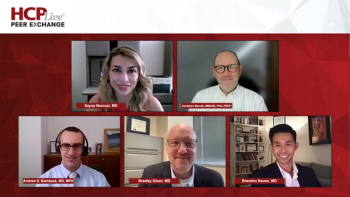
Sayna Norouzi, MD; Jonathan Barratt, MBChB, PhD, FRCP; Andrew S. Bomback, MD, MPH; Bradley Dixon, MD; and Brendon Neuen, MD, discuss how the diagnostic challenges of C3 glomerulopathy (C3G) are addressed, current treatment strategies are explored, and emerging therapies, including insights from the VALIANT trial, may impact clinical practice.

Panelists discuss how the evolving treatment strategies for ATTR-CM highlight the importance of early diagnosis and intervention, focusing on diagnostic tools to expedite diagnosis and recently approved therapies that can impact clinical practice.

Melodie Young, MSN, AGNP-C, FSDNP, DCNP; TJ Chao, MPAS, PA-C; Leigh Ann Pansch, MSN, FNP-BC, DCNP; and Douglas DiRuggiero, DMSc, MHS, PA-C, discuss how the transformative landscape of atopic dermatitis management now incorporates comprehensive severity assessment, personalized treatment goals, and strategic biologic selection based on mechanism of action, patient characteristics, and response patterns—with dupilumab, lebrikizumab, tralokinumab, and nemolizumab offering targeted approaches that demonstrate both rapid relief and long-term efficacy when optimally monitored and supported with appropriate adherence strategies.